
COVERING A WIDE SPECTRUM OF THE MUSIC SCENE ACROSS AMERICA & AROUND THE GLOBE...
CLASSIC ROCK

JOIN US...



Argent is an English rock band founded in 1969 by keyboardist Rod Argent, formerly of The Zombies.
Rod Argent, Chris White (former Zombies bassist, producer, songwriter) and Russ Ballard were the group's songwriters. Some of Ballard's compositions became hits when they were covered by other artists, including Kiss, Petra, Rainbow, Hello , Santana and more recently the brazilian metal band Oficina G3.
Rod Argent went on to work with Andrew Lloyd-Webber, and to produce a couple of solo albums. He also opened a keyboard shop in the West End of London.
Argent's biggest hit was Rod Argent and Chris White's "Hold Your Head Up" from the All Together Now album, which, in a heavily-edited single form, reached #5 in the U.S. It sold over one million copies, and was awarded a gold disc.
Lee Michaels (born Michael Olsen, plays the Hammond organ, piano, and guitar (plus vocals), and is best known for his 1971 Top 10 pop hit single, "Do You Know What I Mean." Michaels began his career with The Sentinals, a San Luis-based surf group that included drummer Johny Barbata, later of The Turtles, Jefferson Airplane, and Jefferson Starship. Michaels joined Barbata in the Strangers, a group led by Joel Scott Hill, before moving to San Francisco. There he joined an early version of The Family Tree, a band led by Bob Segarini. In 1967, he signed a contract with A&M Records, releasing his debut album, Carnival Of Life, later that year. As a session musician, he played with Jimi Hendrix, among others.
Michaels' choice of the Hammond organ as his primary instrument was unusual for the time, as was his bare-bones stage and studio accompaniment: usually just a single drummer, most often a musician known as "Frosty" (Bartholomew Eugene Smith-Frost) a member of Sweathog (band), or with Joel Larson of The Grass Roots. This unorthodox approach attracted a following in San Francisco, and some critical notice, but Michaels did not achieve real commercial success until the release of his fifth album (Fifth), which produced a surprise US Top 10 hit #6 in the fall of 1971, "Do You Know What I Mean" and a Top 40 follow-up, a cover version of the Motown standard, "Can I Get A Witness". Michaels recorded two more albums for A&M before signing a recording contract with Columbia Records in 1973. His Columbia recordings failed to generate much interest, and Michaels went into semi-retirement from the music industry by the end of the decade.
David Thomas "Dave" Mason is an English singer, songwriter, and guitarist from Worcester, who first found fame with the rock band Traffic. In his long career, Mason has played and recorded with many of the era's most notable rock musicians, including Jimi Hendrix, Delaney Bramlett, Michael Jackson, The Rolling Stones, Eric Clapton, George Harrison, Fleetwood Mac and Cass Elliot. Mason's best known song is "Feelin' Alright", recorded by Traffic in 1968 and later by many other performers, including Joe Cocker, who had a major hit with the song in 1969. "We Just Disagree", Mason's 1977 solo hit written by Jim Krueger, has become a staple of Oldies and Adult Contemporary radio playlists.

David Allen "Dave" Loggins is a singer, songwriter and musician. He is widely remembered for his 1974 composition "Please Come to Boston", which was a top-10 hit in the U.S. for him, and was subsequently covered by numerous other artists. He was inducted into the Nashville Songwriters Hall of Fame in 1995. Besides being a musician, Loggins was previously employed as a draftsman at Bristol Metals, and as an insurance salesman. He is a cousin of singer/songwriter Kenny Loggins.
In addition to his recording of "Please Come to Boston" reaching #5 on the U.S. pop chart in 1974, the song also topped the Billboard Easy Listening survey.
Loggins also wrote "Pieces of April" for Three Dog Night, which became a top-20 hit in 1973. He has written material for Restless Heart, Wynonna Judd, Reba McEntire, Gary Morris, Alabama, Toby Keith, Don Williams, and the #1 hit "Morning Desire" by Kenny Rogers. He recorded a #1 country song with Anne Murray in 1984 called "Nobody Loves Me Like You Do" which won a CMA Award.
Loggins also composed the theme music "Augusta" that is used on broadcasts of the The Masters Golf Tournament. "Augusta" was later released as part of a collection of songs about golf called The New Course Record. On this recording, Loggins shared the vocal duties with Birmingham-based singer and pianist Ray Reach. The arranging duties were shared by Don Hays and Ray Reach. Hays shared the producer's role with Mike Geselbracht and noted Nashville musician and producer Mike Chapman.
Little River Band is an Australian rock band, formed in Melbourne in early 1975. The group chose the name after passing a road sign leading to the Victorian township of Little River, near Geelong, on the way to a performance. Little River Band enjoyed sustained commercial success in not only Australia, but also in the United States. During its career, the band sold more than 25 million records and achieved 13 U.S. Top 40 hits - to add to awards gained in Australia.
The band's original members were: lead vocals Glenn Shorrock; acoustic guitar & vocals Graeham Goble; rhythm guitar & vocals Beeb Birtles; lead guitar Ric Formosa; bass guitar Roger McLachlan; and drummer Derek Pellicci. The music and lyrics for most of the group's compositions were contributed by Goble and Shorrock primarily — with contributions from Birtles and Briggs.
In May 2001 the Australasian Performing Right Association (APRA), as part of its 75th Anniversary celebrations, named "Cool Change", written by Shorrock, as one of the Top 30 Australian songs of all time. The 'classic line-up' of Birtles, Goble, Pellicci, Shorrock, guitarist David Briggs and bass guitarist George McArdle, were inducted into the Australian Recording Industry Association (ARIA) Hall of Fame at the 18th Annual ARIA Music Awards of 2004.
The Hollies are an English pop and rock group, formed in Manchester in the early 1960s, though most of the band members are from throughout East Lancashire. Known for their distinctive vocal harmony style, they became one of the leading British groups of the 1960s and 1970s. They enjoyed considerable popularity in many countries, although they did not achieve major US chart success until 1966. Along with The Rolling Stones and The Searchers, they are one of the few British pop groups of the early 1960s that have never officially broken up and that continue to record and perform. The Hollies were inducted to the Rock and Roll Hall of Fame in 2010.
The original line-up included Allan Clarke as lead vocalist, Graham Nash as guitarist and vocalist, Vic Steele on guitar, with Eric Haydock on bass guitar and Don Rathbone on drums.
Simple Minds are a Scottish rock band who achieved worldwide popularity from the mid-1980s to the early 1990s.
The band produced a handful of critically acclaimed albums in the early 1980s and best known for their #1 US, Canada and Netherlands hit single "Don't You (Forget About Me)", from the soundtrack of the John Hughes movie The Breakfast Club, #3 US hit single "Alive and Kicking" and #1 UK hit single "Belfast Child". The band has sold more than 60 million albums since 1979.
The core of the band is the two remaining founder members - Jim Kerr (vocals, songwriting) and Charlie Burchill (guitars, keyboards after 1990, other instruments, songwriting) - and drummer Mel Gaynor (who first joined the band in 1982).
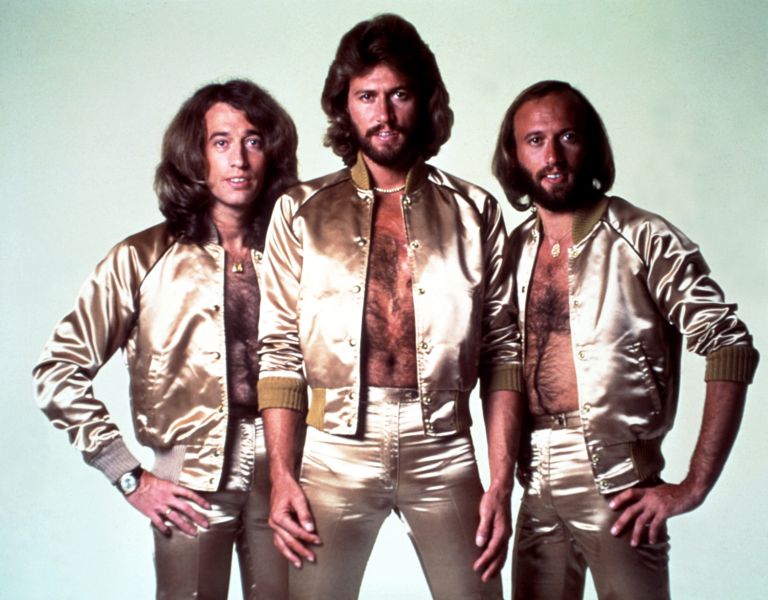
The Bee Gees are a musical group which originally comprised three brothers: Barry, Robin, and Maurice Gibb. The trio were successful for most of their decades of recording music, but they had two distinct periods of exceptional success: as a pop act in the late 1960s/early 1970s, and as prominent performers of the disco music era in the late 1970s. The group sang three-part tight harmonies that were instantly recognizable; Robin's clear vibrato lead was a hallmark of their earlier hits, while Barry's R&B falsetto became their signature sound during the late 1970s and 1980s. The brothers co-wrote all of their own hits, as well as writing and producing several major hits for other artists.
Born in the Isle of Man to English parents, the Gibb brothers lived their first few years in Chorlton, Manchester, England, then moved in the late 1950s to Redcliffe, Queensland, Australia, where they began their musical careers. After achieving their first chart success in Australia with "Spicks and Specks" (their 12th single), they returned to the United Kingdom in January 1967 where producer Robert Stigwood began promoting them to a worldwide audience. It has been estimated that the Bee Gees' career record sales total more than 220 million,making them one of the best-selling music artists of all time. They were inducted into the Rock and Roll Hall of Fame in 1997; the presenter of the award to "Britain's first family of harmony" was Brian Wilson, historical leader of the Beach Boys, a "family act" also featuring three harmonizing brothers. The Bee Gees' Hall of Fame citation says "Only Elvis Presley, The Beatles, Michael Jackson, Garth Brooks and Paul McCartney have outsold the Bee Gees".
Following Maurice's sudden death in January 2003, Barry and Robin Gibb ended the group after 45 years of activity. In 2009, however, Robin announced that he and Barry had agreed that the Bee Gees would re-form and perform again.

Queen are a British rock band formed in London in 1971, originally consisting of Freddie Mercury (lead vocals, piano), Brian May (guitar, vocals), John Deacon (bass guitar, guitars, vocals), and Roger Taylor (drums, vocals). Queen's earliest works were influenced by progressive rock, but the band gradually ventured into more conventional and radio-friendly works, incorporating more diverse and innovative styles in their music.
Before joining Queen, Brian May and Roger Taylor had been playing together in a band named Smile with bassist Tim Staffell. Freddie Mercury (then known as Farrokh/Freddie Bulsara) was a fan of Smile, and encouraged them to experiment with more elaborate stage and recording techniques after Staffell's departure in 1970. Mercury himself joined the band shortly thereafter, changed the name of the band to "Queen", and adopted his familiar stage name. John Deacon was recruited prior to recording their eponymous debut album (1973). Queen enjoyed success in the UK with their debut and its follow-up, Queen II (1974), but it was the release of Sheer Heart Attack (1974) and A Night at the Opera (1975) that gained the band international success. The latter featured "Bohemian Rhapsody", which stayed at number one in the UK Singles Chart for nine weeks; it charted at number one in several other territories, and gave the band their first top ten hit on the US Billboard Hot 100. Their 1977 album, News of the World, contained two of rock's most recognizble anthems, "We Will Rock You" and "We Are the Champions". By the early 1980s, Queen were one of the biggest stadium rock bands in the world, and their performance at 1985's Live Aid is regarded as one of the greatest in rock history. In 1991, Mercury died of bronchopneumonia, a complication of AIDS, and Deacon retired in 1997. Since then, May and Taylor have infrequently performed together, including a collaboration with Paul Rodgers under the name Queen + Paul Rodgers which ended in May 2009.
The band has released a total of 18 number one albums, 18 number one singles, and 10 number one DVDs. Estimates of their album sales generally range from 150 million to 300 million albums, making them one of the world's best-selling music artists. They have been honored with seven Ivor Novello awards and were inducted into the Rock and Roll Hall of Fame in 2001.
The Freddie Mercury Tribute Concert for AIDS Awareness was an open-air concert held on Easter Monday, 20 April 1992 at London's Wembley Stadium, for an audience of 72,000. The concert was produced for television by Ray Burdis and broadcast live on television and radio to 76 countries around the world, with an audience of up to one billion. The concert was a tribute to the life of the late Queen frontman, Freddie Mercury, with all proceeds going to AIDS research. The show marked bassist John Deacon's final concert with Queen (save two live appearances with Brian May, Roger Taylor and Elton John in 1997). The profits from the concert were used to launch The Mercury Phoenix Trust AIDS charity organization.
Following Freddie Mercury's death on 24 November 1991 from bronchopneumonia brought on by AIDS, the remaining members of Queen (John Deacon, Brian May and Roger Taylor) came together with Queen Manager Jim Beach to organise an open air concert to celebrate the life and legacy of Mercury, as well as raise money for AIDS research, and spread awareness about the disease. In February 1992, at the annual BRIT Awards ceremony, May and Taylor announced plans for the concert. When tickets finally went on sale, all 72,000 tickets sold out in just three hours, even though no performers were announced apart from remaining members of Queen.
Sir Elton Hercules John, CBE (born Reginald Kenneth Dwight) is an English rock singer-songwriter, composer, pianist and occasional actor. He has worked with lyricist Bernie Taupin as his songwriter partner since 1967; they have collaborated on more than 30 albums to date.
In his four-decade career John has sold more than 250 million records, making him one of the most successful artists of all time. His single "Candle in the Wind 1997" has sold over 33 million copies worldwide, and is the best selling single in Billboard history. He has more than 50 Top 40 hits, including seven consecutive No. 1 US albums, 56 Top 40 singles, 16 Top 10, four No. 2 hits, and nine No. 1 hits. He has won six Grammy Awards, four Brit Awards, an Academy Award, a Golden Globe Award and a Tony Award. In 2004, Rolling Stone ranked him Number 49 on its list of the 100 greatest artists of all time.
John was inducted into the Rock and Roll Hall of Fame in 1994. Having been named a Commander of the Order of the British Empire in 1996, John received a knighthood from Queen Elizabeth II for "services to music and charitable services" in 1998. John has performed at a number of royal events, such as the funeral of Princess Diana at Westminster Abbey in 1997, and the Queen's Diamond Jubilee Concert outside Buckingham Palace in 2012.
He has been heavily involved in the fight against AIDS since the late 1980s. In 1992, he established the Elton John AIDS Foundation and a year later began hosting the annual Academy Award Party, which has since become one of the most high-profile Oscar parties in the Hollywood film industry. Since its inception, the foundation has raised over $200 million.
Van Halen is a Dutch-American rock band formed in Pasadena, California, in 1972. Its 1978 debut album, Van Halen—featuring guitarist Eddie Van Halen, vocalist David Lee Roth, drummer Alex Van Halen, and bassist Michael Anthony—is widely considered to be among the most "original" and "revolutionary" albums to "change rock and roll."
According to the Recording Industry Association of America, Van Halen is the 19th best-selling band/artist in United States history, with sales of over 56 million albums in the U.S. and over 86 million albums worldwide, (with the band's former record company, Warner Bros. Records, last certifying Van Halen's albums in 2004.) Van Halen is one of only five rock bands that have had two albums sell more than 10 million copies in the U.S. Additionally, Van Halen has had the most #1 hits in the history of Billboard's Mainstream Rock chart.
In addition to Van Halen's many popular songs, the band is known for the drama surrounding the exits of former members. The multiple exits of lead singers David Lee Roth, Sammy Hagar and Gary Cherone were surrounded in controversy and press coverage, including numerous conflicting press statements between the former singers and the band. Following their 2004 concert tour the band was on a hiatus from the public until September 2006, when new bassist Wolfgang Van Halen's place was confirmed and Roth reunion rumors began to re-surface, both events coinciding with the band's Rock and Roll Hall of Fame induction on March 12, 2007. After years of speculation, Van Halen began a tour with Roth across North America in 2007 and into 2008. On December 26, 2011, Van Halen announced a tour for 2012, and released their first album in 14 years, A Different Kind of Truth, on February 7, 2012.
Molly Hatchet is an American southern metal band formed in Jacksonville, Florida, in 1975. They are known for their hit song "Flirtin' with Disaster" from the album of the same title. The band, founded by Dave Hlubek and Steve Holland, took its name from a prostitute who allegedly mutilated and decapitated her clients. Most of Molly Hatchet album covers feature heroic fantasy inspired art, some of which were painted by artists Frank Frazetta and Boris Vallejo.
Based in Jacksonville, Florida, Molly Hatchet shared influences and inspiration with the most well-known act in the Southern rock genre, Lynyrd Skynyrd as well as another up-and-coming Southern rock act, .38 Special, who referred them to manager Pat Armstrong. His interest in Molly Hatchet led to a recording contract with Epic Records, bringing in Tom Werman as a producer. Werman had already worked with acts such as Cheap Trick, Stranger and Ted Nugent. Ronnie Van Zant was slated to produce Molly Hatchet's first album, having helped in writing arrangements and directing rehearsals prior to his fatal airplane crash. Molly Hatchet actually cut their first demos in Lynyrd Skynyrd's 8-track recording studio using their equipment. Other demos were cut in Jacksonville's infamous Warehouse Studios and "shopped", and Warner Brothers expressed interest. Warner Brothers' A&R could not decide whether to sign Molly Hatchet or another promising band they had been working with at that same time. They ended up being turned down by Warner Brothers and would later discover that the competing band was none other than Van Halen. Within six months they signed to Epic Records.
Prior to the band's signing with Epic Records, they often toured the Florida roadhouse and bar circuit. Dave Hlubek was the band's vocalist prior to Danny Joe Brown, and wrote and co-produced many of the band's songs. Hlubek has stated that the demise of Lynyrd Skynyrd – who were at the height of their success – opened the door for Molly Hatchet.
